What Are the 3 Main Symptoms of Autism?
- By I Support Foundation Posted On - 25/08/2026
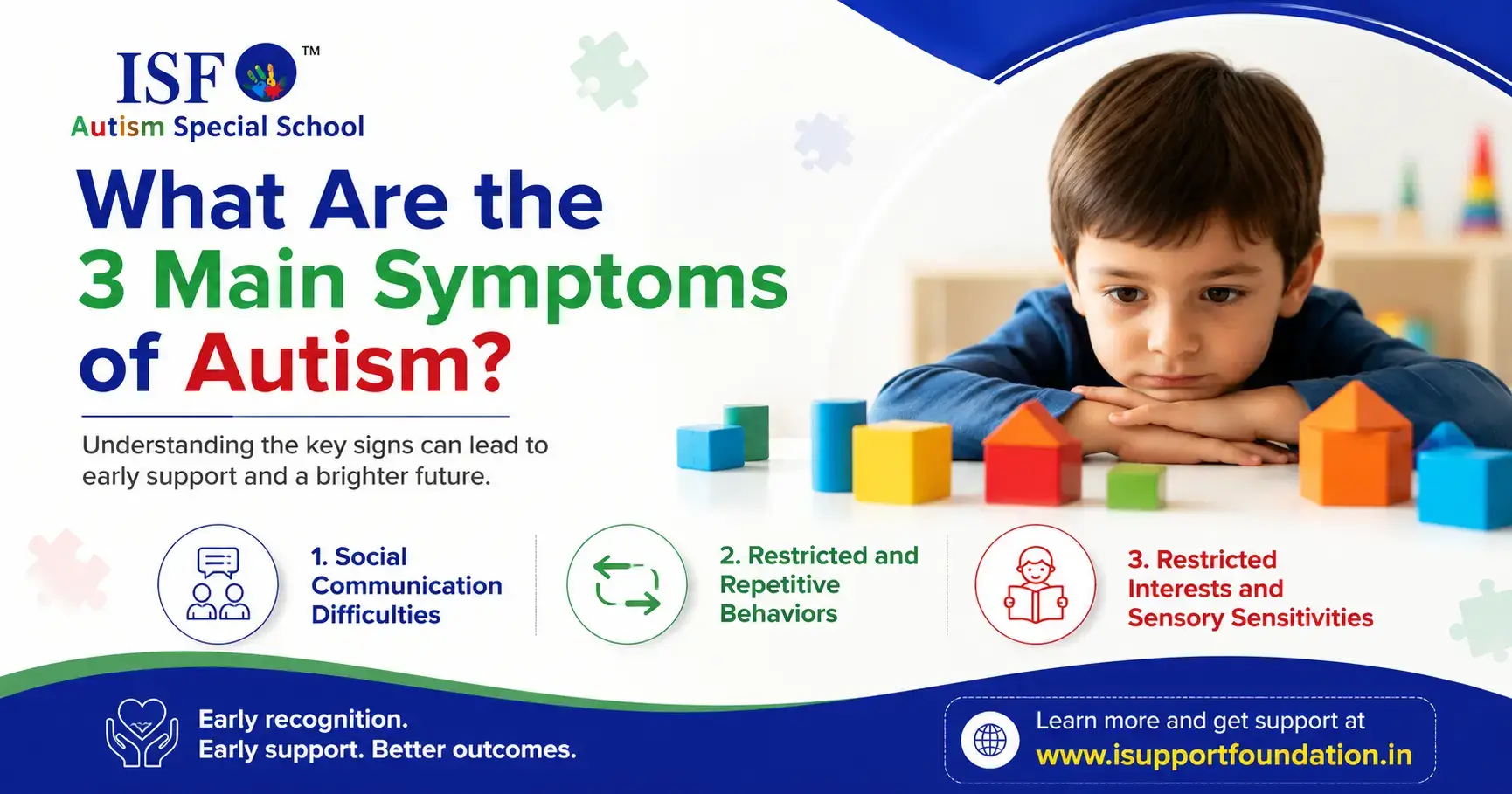
Social communication problems, restricted and repetitive behaviors and sensory differences and/or restricted interests are the 3 main symptoms of autism. Signs of autism vary from one child to another. Early signs that the doctor wants to see include more than one of the symptoms mentioned below to ensure a correct assessment by a pediatrician, or other specialist.
What Is Autism?
Autism is defined as a childhood developmental disorder that
interferes with the way in which a child relates to his or her
environment and other people and the way that the child processes
information and perceives the world around him/her. It is known as
a "spectrum," and symptoms can be anything from mild to severe.
Parenting is not the cause of autism. It is a developmental
difference that is apparent in early childhood, typically before
age three.
The 3 Main Symptoms of Autism
There are three major areas of autism symptoms, as presented by doctors and specialists :Social Communication Difficulties
For many autistic children, communication is challenging and difficult to use and understand in the same way as for other children. This may be in the form of eye contact, facial expression, tone of voice and reciprocal speech.
For instance, a young child might not point to indicate something of interest, or might not turn their head when they're called even if they are able to hear.
Restricted & Repetitive Behaviors
This symptom manifests as repetitive behavior/sequences of behavior, like hand flapping, rocking, lining up toys instead of playing with them or repeating the same phrase over and over again.
Routine is important to many children too. Some children find changes to their daily routines disturbing.
Restricted Interests & Sensory Differences
An autistic child might focus only on one thing in particular, like maybe trains or numbers. And everything they say would be about that subject. Everyday things that normal people wouldn't worry about, like textures or light, or a tag on a T-shirt causing an itchy sensation or a noise from a hand dryer can be disturbing to an autistic child.
Early Signs of Autism by Age
| Age | Possible Early Signs | Age | Possible Early Signs |
|---|---|---|---|
| 12–18 months | Slight or no babbling, does not point, does not answer to his name | 18–24 months | Minimal words and pretend play, plays mostly alone |
| 2–3 years | Repeats phrases (echolalia), has a strong resistance to changes in routine | 3–5 years | Having difficulty making friends, limited interests, over-sensitivities |
One sign of development doesn't indicate that a child is autistic; all children develop in their own time. The consistency and combination of signs is important.
How These Symptoms Look in Everyday Life
In the home environment: A child might like to put toy cars into a line-up instead of pretending they were in a race, or become upset when dinner is served on an alternate plate.
In school: A child might not be able to join in group games or might correct facts about their favorite subject without realizing that he/she is being noticed by a classmate.
Not all of these autism red flags will be evident in one child and so two autistic children may look very different.
When Should Parents Seek an Autism Evaluation?
If your child exhibits a few signs at the same time, you may want to arrange for an autism screening if your child:
- Avoid babbling, pointing and gesturing by 12 months.
- By 24 months, have two-word phrases and by 16 months have no single words.
- Become unable to speak or understand language or social skills that they previously had.
- Avoid eye contact or rarely respond to their name.
- Show strong, repeated behaviors that interfere with daily life.
It is critical to listen to a parent’s intuition. Never underestimate a gut instinct; it is never too early to have your concerns addressed and get professional insight into your baby’s development.
How Autism Is Diagnosed
Only a trained professional, including a developmental pediatrician, child psychologist, or psychiatrist, can diagnose autism. There is no blood test to diagnose autism. Rather, experts watch the child's actions, check the child's development history, and complete a series of structured questionnaires and assessments of the child's play at several appointments before making a diagnosis.
Can a Child Have One Symptom But Not Autism?
Yes. A child may be shy, have a strong hobby and not like loud noises and still not be autistic. Only then does autism become a consideration because there are multiple symptoms that are present simultaneously, are enduring, and interfere with the child's functioning. Parents should not self-diagnose autism based on one characteristic, only a qualified professional can diagnose autism.
Conclusion
Each child with autism is different and symptoms vary from mild to severe. Early signs of autism in your child are a good reason to look for an evaluation, not a reason to be afraid.
I Support Foundation provides special education, speech, occupational therapy, and ABA therapy to children on the autism spectrum, and supports parents in their parenting journey. If you have any concerns about your child's development, you can contact a team that is knowledgeable about early intervention, and who can help you to understand what to expect next and how it can be supported.
Frequently Asked Questions
What are the 3 main symptoms of autism?
Social communication differences, limited/repetitive behaviors, and limited interests or sensory differences.
At what age do autism symptoms usually appear?
Early signs appear between 12 and 24 months, although some children may not be identified until in preschool.
Can autism be diagnosed before age 2?
Yes, although many diagnoses are made between the ages of 2-4 when symptoms are more obvious.
Can autism symptoms in toddlers change over time?
Yes, symptoms may be more or less apparent as a child grows, particularly if early intervention is used.
Are autism symptoms in children the same for boys and girls?
Symptoms may manifest in different ways in girls and women – they may be better at hiding social problems.
What are common autism warning signs parents should never ignore?
The loss of skills a child once had, not responding to his/her name and no words by 16 months are red flags that should be taken seriously and acted upon promptly.
Does having one symptom mean my child has autism?
No. Just one characteristic, such as sensitivity to loud sounds, is not sufficient to make a diagnosis of Autism.
Can therapy improve autism symptoms?
Yes, children can develop communication and daily living skills through therapy over time, such as speech, occupational or ABA therapy.
Is autism the same as ADHD?
No, although they can be combined. The key differences between ADHD and autism lie in the areas of attention and impulse control (ADHD) versus social communication and behavior (autism).
What should I do if I notice signs of autism in my child?
Speak with your pediatrician about having a comprehensive evaluation of your child's autism conducted by a developmental professional.